
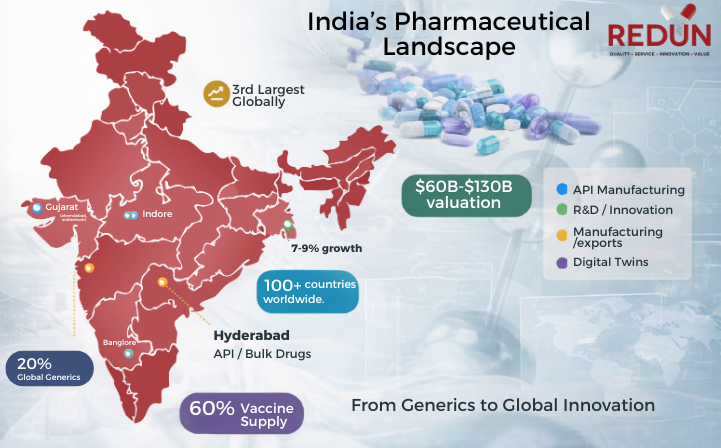
India has been widely regarded as the “Pharmacy of the World” for a long time. But as we move further into 2026, that title feels like an understatement. India has moved beyond its role as a market leader, realigning structurally and evolving from a generic manufacturer to a premium partner in global innovation.
While the previous decade revolved around building the foundation, 2026 is a new chapter in superiority. By integrating Bengaluru’s AI-powered labs and the “smart” factory floors of Indore and Hyderabad, India has moved beyond being a mere participant and is redefining the future of global healthcare. This blog explores how the pharmaceutical manufacturers in India are driving this landmark revolution in the global medical industry.
The Operational Shift: From Mass Production to High-Value Innovation
As of 2026, India has cemented its place as a powerhouse, ranking 3rd globally in pharmaceutical production volume. While the numbers are mind-boggling, there’s more to it than meets the eye.
This progress is fuelled by a combination of strategic government initiatives, tech-driven processes, and a new emphasis on specialty medicines.
The mission has evolved. While affordability remains the bedrock, the new focal point is quality and innovation. Several leading pharmaceutical companies of India have embedded advanced AI and machine learning into their R&D pipelines to deliver life-saving medicines to patients much faster globally.
The Rise of the API Manufacturer India
Perhaps the biggest shift in the last two years has been India’s strategic push toward domestic autonomy and scaling down foreign dependencies. Moving away from depending on others to import raw materials, the role of a local API manufacturer India has become more critical.
Achieving Supply Chain Sovereignty
By leveraging government-led policies like the Production Linked Incentive (PLI) program, India has successfully slashed its need to import Key Starting Materials (KSMs).
The Industry Giants: Top Pharmaceutical Companies of India
The current market landscape is defined by both long-standing pharma giants and agile biotech startups. Leading pharmaceutical companies of India like Sun Pharma, Dr. Reddy’s, Cipla, and Lupin have successfully expanded their international operations and are now serving patients across 100+ countries worldwide.
Global Market Leadership
These companies are no longer confined to the Indian market. They have evolved and now operate as players on the international stage.
Digitisation: Pharma 4.0
The concept of “smart factory” has transitioned into an industry benchmark rather than a mere trend in 2026. With the implementation of ‘Digital Twins’ technology, major pharmaceutical companies in India are now employing virtual models of their manufacturing processes to foresee equipment failure in real-time before a single pill is ever made.
AI and Data-Driven Healthcare
AI has moved from being a premium feature to a fundamental necessity. Integrating AI-driven pharmacovigilance and safety tracking has become the basis for regulatory compliance. In addition, the implementation of blockchain provides an unalterable audit trail, ensuring transparency from any API manufacturer in India to global retail pharmacies.
Quality Compliance and Regulatory Standards
India’s decision shift to the new Schedule M guidelines is a big step forward for the industry, bringing local manufacturing in line with global Good Manufacturing Practices (GMP).
Beyond 2026 and into the Future:
Moving forward, genomics and personalized medicine mark the next era of medical science and innovation. Through the 2026 budget, the “Biopharma SHAKTI” initiative is designed to transform India’s presence as a global powerhouse for large-molecule biologics, thus broadening the horizons for every major pharmaceutical manufacturing company in India.