Pharma Marketing Strategy: The New Growth Flywheel in Indian Pharma
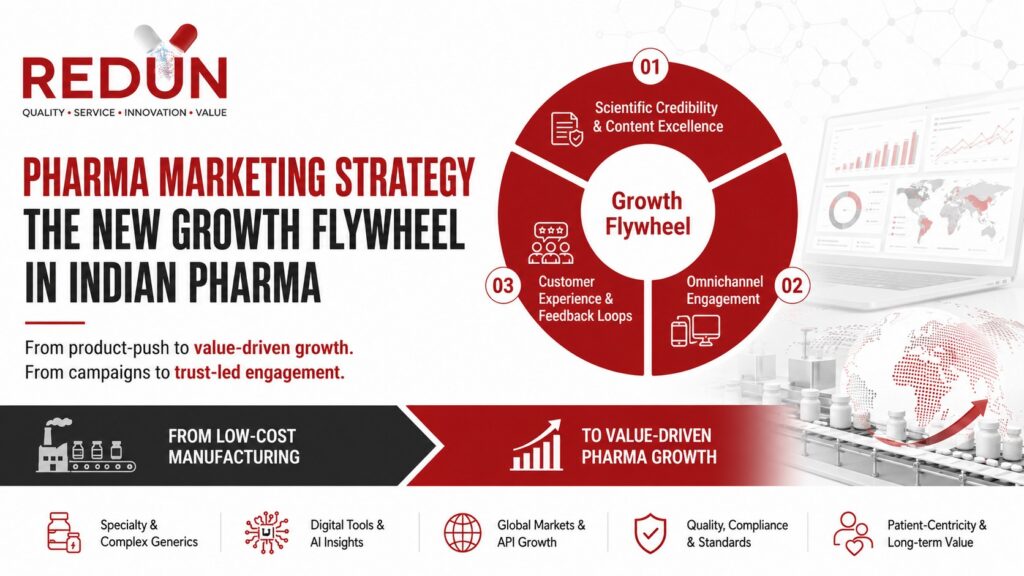
The Indian pharmaceutical industry is moving up the global value chain toward complex innovation, digital healthcare solutions, and integrated healthcare services, replacing low-cost manufacturing as the primary growth engine. Rather than relying on old methods, companies are redesigning their interaction approach by prioritizing more meaningful connections with doctors, patients, and global markets. This transformation is powered by a ‘pharma brand growth flywheel’, a sophisticated modern pharma marketing strategy, in which brand identity, digital interactions, and seamless customers experiences work in tandem to create compounding commercial momentum. Today, the importance of pharmaceutical marketing has evolved beyond simply pushing products to foster long-term, trust-based supportive experience for both doctors and patients. It has transitioned into a strategic bridge that builds brand perception, informs key stakeholders, and drives long-term market loyalty. Doctors are now prioritizing personalized, data-driven insights over traditional promotional messaging. Conversely, patients are better informed than ever in managing their healthcare journey, actively researching options to stay ahead of their treatment choices. Marketing has shifted from a traditional support service to becoming a central driver for business expansion. Organizations that invest in omnichannel engagement, scientific communication, and trust-driven storytelling are the ones breaking through the noise in an overcrowded marketplace. Pharma Marketing Strategy: The Flywheel Approach The ‘flywheel’ model rethinks how growth is accomplished. A successful pharma marketing strategy should operate as a closed-loop system where every activity, data point, and engagement acts as a catalyst that reinforces the next. At its core, the flywheel concept consists of three interconnected forces: 1. Scientific Credibility and Content Excellence Pharma companies must establish authority through robust clinical results, real-world case studies, and insightful educational content. This approach builds credibility with healthcare professionals and anchors every brand marketing plan. 2. Omnichannel Engagement Doctors and patients engage across multiple touchpoints, transitioning from online portals, live webinars, in-clinic materials, and more. A synchronized experience across these channels guarantees more meaningful interactions that keep your audience more involved. 3. Customer Experience and Feedback Loops Each engagement yields valuable information. By analyzing this data, companies can refine their narrative and deliver more relevant content, and boost performance over time. This sparks a powerful feedback loop where every positive interaction streamlines the journey, reduces friction, and accelerates brand expansion. Pharmaceutical Business Model in Transition The traditional pharmaceutical business model in India has been volume-driven, with a strong focus on generics and cost efficiency. However, this model is evolving rapidly due to regulatory changes, global competition, and shifting market expectations. Looking ahead to 2026–2028, the industry is expected to see: This evolution demands a parallel shift in marketing. Companies can no longer rely on scale alone; they must build distinctive brands and deliver measurable value to stakeholders. Is Pharmaceutical Business Profitable? A common question that arises: is pharmaceutical business profitable in today’s dynamic environment? The answer is yes, but profitability is becoming more nuanced. Margins in traditional generics are under pressure due to pricing regulations and competition. However, opportunities are emerging in areas such as: For instance, the US API market is projected to grow steadily through 2035, driven by demand for high-quality, compliant manufacturing. Indian companies with strong capabilities in this space are well-positioned to capture value. Profitability, therefore, depends on strategic positioning. Companies that align their pharma marketing strategy with high-growth segments and global standards will see better returns. Connecting Marketing with Market Reality The future of Indian pharma lies at the intersection of innovation, regulation, and market access. A forward-looking pharma marketing strategy must account for these dynamics. From the broader industry outlook, several trends stand out: Marketing teams must adapt quickly to these changes. Static campaigns and standardized messaging will no longer suffice. Instead, agility, personalization, and continuous learning are key. Building a Sustainable Growth Engine To implement an effective flywheel, companies should focus on a few critical enablers: Marketing, medical, and sales functions must work collaboratively rather than in silos. This ensures consistency and maximizes impact. CRM systems, analytics platforms, and AI tools can help track engagement, predict behavior, and optimize campaigns. High-quality, relevant content tailored to different stakeholders is essential for building trust and driving engagement. Clear metrics and Key Performance Indicators (KPIs) allow companies to evaluate performance and refine their approach continuously. By aligning these elements, the pharmaceutical business model becomes more resilient and adaptable. What Lies Ahead The Indian pharmaceutical industry is poised for significant transformation over the next decade. Growth will not come from incremental improvements but from reimagining how companies operate and engage with their audiences. A well-executed pharma marketing strategy built on the flywheel principle can serve as a powerful catalyst. It shifts the focus from short-term gains to long-term value creation, ensuring sustained growth in an increasingly competitive landscape. For businesses willing to embrace this change, the opportunity is immense. By combining scientific excellence, digital innovation, and customer-centric thinking, they can not only remain profitable but also lead to the next wave of global pharmaceutical growth. Build a smarter pharma growth engine today. Visit: https://redunpharma.com/
Overview of the Pharmaceutical Industry in India
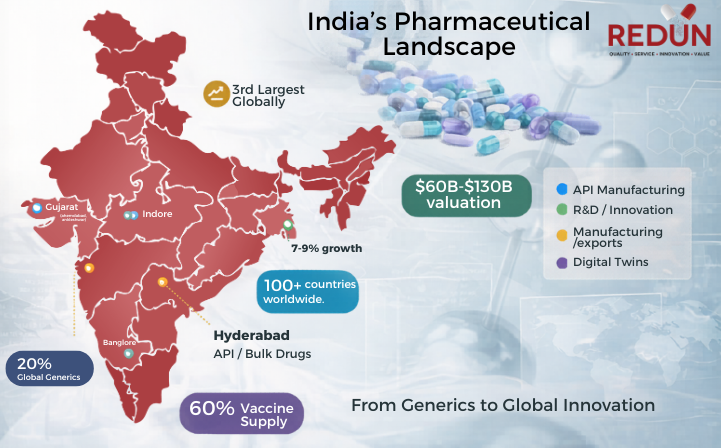
India has been widely regarded as the “Pharmacy of the World” for a long time. But as we move further into 2026, that title feels like an understatement. India has moved beyond its role as a market leader, realigning structurally and evolving from a generic manufacturer to a premium partner in global innovation. While the previous decade revolved around building the foundation, 2026 is a new chapter in superiority. By integrating Bengaluru’s AI-powered labs and the “smart” factory floors of Indore and Hyderabad, India has moved beyond being a mere participant and is redefining the future of global healthcare. This blog explores how the pharmaceutical manufacturers in India are driving this landmark revolution in the global medical industry. The Operational Shift: From Mass Production to High-Value Innovation As of 2026, India has cemented its place as a powerhouse, ranking 3rd globally in pharmaceutical production volume. While the numbers are mind-boggling, there’s more to it than meets the eye. This progress is fuelled by a combination of strategic government initiatives, tech-driven processes, and a new emphasis on specialty medicines. The mission has evolved. While affordability remains the bedrock, the new focal point is quality and innovation. Several leading pharmaceutical companies of India have embedded advanced AI and machine learning into their R&D pipelines to deliver life-saving medicines to patients much faster globally. The Rise of the API Manufacturer India Perhaps the biggest shift in the last two years has been India’s strategic push toward domestic autonomy and scaling down foreign dependencies. Moving away from depending on others to import raw materials, the role of a local API manufacturer India has become more critical. Achieving Supply Chain Sovereignty By leveraging government-led policies like the Production Linked Incentive (PLI) program, India has successfully slashed its need to import Key Starting Materials (KSMs). The Industry Giants: Top Pharmaceutical Companies of India The current market landscape is defined by both long-standing pharma giants and agile biotech startups. Leading pharmaceutical companies of India like Sun Pharma, Dr. Reddy’s, Cipla, and Lupin have successfully expanded their international operations and are now serving patients across 100+ countries worldwide. Global Market Leadership These companies are no longer confined to the Indian market. They have evolved and now operate as players on the international stage. Digitisation: Pharma 4.0 The concept of “smart factory” has transitioned into an industry benchmark rather than a mere trend in 2026. With the implementation of ‘Digital Twins’ technology, major pharmaceutical companies in India are now employing virtual models of their manufacturing processes to foresee equipment failure in real-time before a single pill is ever made. AI and Data-Driven Healthcare AI has moved from being a premium feature to a fundamental necessity. Integrating AI-driven pharmacovigilance and safety tracking has become the basis for regulatory compliance. In addition, the implementation of blockchain provides an unalterable audit trail, ensuring transparency from any API manufacturer in India to global retail pharmacies. Quality Compliance and Regulatory Standards India’s decision shift to the new Schedule M guidelines is a big step forward for the industry, bringing local manufacturing in line with global Good Manufacturing Practices (GMP). Beyond 2026 and into the Future: Moving forward, genomics and personalized medicine mark the next era of medical science and innovation. Through the 2026 budget, the “Biopharma SHAKTI” initiative is designed to transform India’s presence as a global powerhouse for large-molecule biologics, thus broadening the horizons for every major pharmaceutical manufacturing company in India.